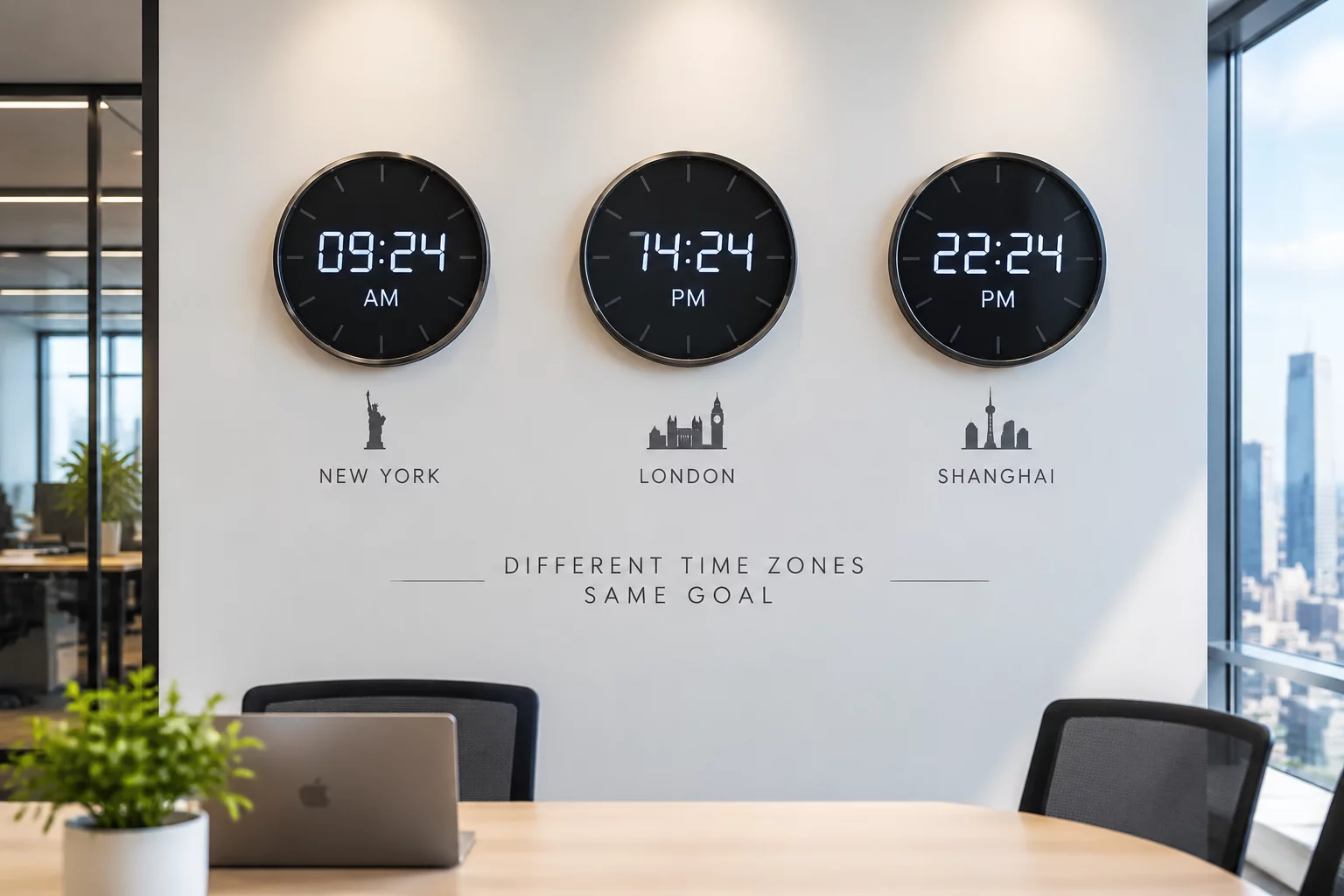
The Geometry of Three Global Hubs
Distributing operations across North America, Europe, and the Asia-Pacific region gives an organization the rare capability to advance initiatives around the clock. When one regional unit finishes its workday, the next team picks up the baton with fresh energy, validating code merges, unblocking customer tickets, and testing critical infrastructure deployments. Treating this international arrangement like an always-on synchronous chat channel degrades team focus, prompts notification burnout, and causes critical dependencies to stall.
The true benefit of a three-zone topology materializes only when real-time assumptions are replaced with structured transfer checkpoints. Instead of expecting late-night attendance on calls or early morning wake-up check-ins, teams summarize their progress, test suites, and blockers into standardized transfer packets that cross oceans asynchronously.
Continuous progression across three international hubs does not require team members to work continuously. The work travels smoothly across time zones while team members enjoy uninterrupted rest.
Four Core Rules for a Seamless Relay
Passing operational context over eight-hour time differences requires concrete artifacts rather than unstructured dialogue. High-performing global teams enforce four clear rules during every shift change:
- Explicit State Declaration: Avoid leaving tasks tagged with ambiguous labels; record exact branch states, passing test counts, and pending environmental variables.
- Single Source Anchoring: Attach every ticket identifier, pull request link, and design revision directly to the primary handoff thread.
- Actionable Priority Routing: Clearly state whether incoming engineers should review, test, release, or hold until external client verification arrives.
- Defined Escalation Thresholds: Specify unambiguous boundaries for when an incident warrants paging an off-shift lead versus logging a note for their next morning.
Applying these rules eliminates the confusion that frequently hampers early morning starts. When developers in London start their day, they access concise summaries produced by teammates in San Francisco and Singapore, jumping directly into implementation rather than untangling conversational threads.
Dedicate the natural 30-minute operational overlap solely to publishing clean context logs rather than hosting extended status meetings.
Unblocking Decisions Without Halting Momentum
The most frequent barrier in a tri-zone rhythm is decision paralysis. An engineer in Sydney may discover an architectural question in the afternoon while the lead architect in London is still asleep. Waiting for real-time approval risks stalling work for an entire business day.
High-performing distributed organizations solve this with reversible decision authority and explicit fallback paths. Team members are empowered to proceed with two-way-door choices while documenting their assumptions in the handoff thread. If a correction is needed, the incoming region reviews the rationale and adjusts course without losing eight hours of productive engineering time.
Standardize Your Tri-Zone Workflows
Explore battle-tested handoff frameworks and structured team workflows.